

CALL US AT (804) 285-7333

U

Jan 21, 2024 | Investment Management, Q&A

Should I be concerned about the presidential election’s impact on the market?

Tags:
Voting booths representing the presidential election

S&P 500 Return During Presidential Election Years

Policy uncertainty is predictably at its peak during election years. If there is one thing the stock market hates, it is uncertainty. However, a review of historical data shows little correlation between national presidential election outcomes and capital market performance. Despite intra-year price volatility, annual returns for the S&P 500 during election years have largely been positive. As illustrated in Figure 1, going back to 1952, the S&P 500 has enjoyed positive returns in every election year where an incumbent was in the race.
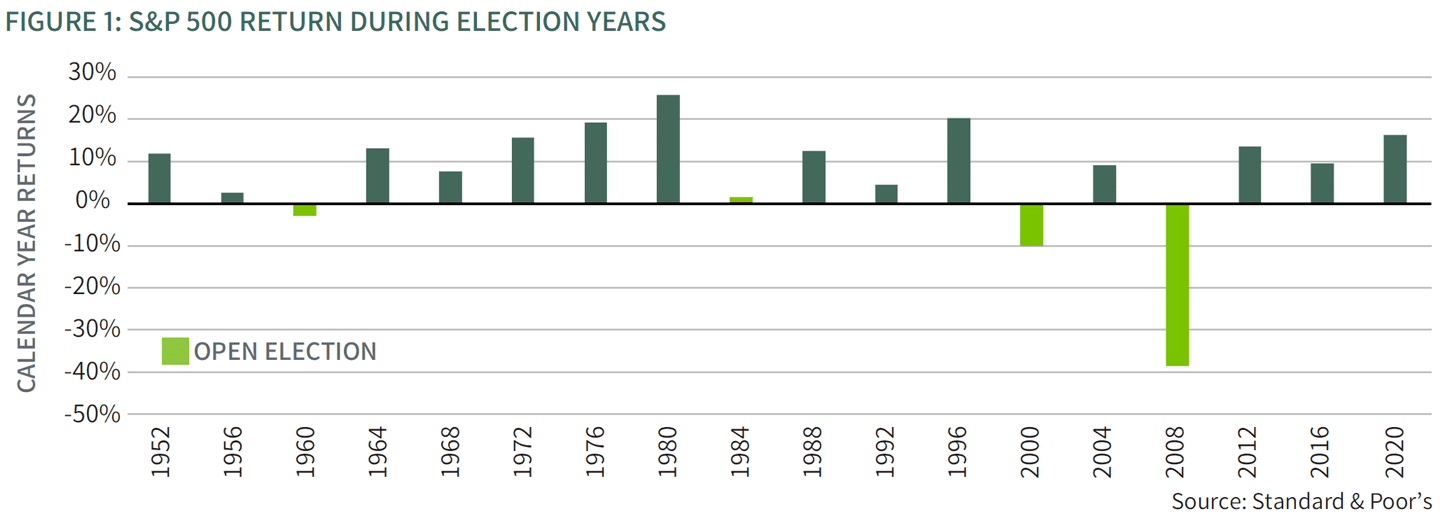
Graph showing the S&P 500 Return during presidential election years.

The Effect of a Divided Government on the Market

Markets perform best when uncertainty is minimized. It has been historically hard for administrations to achieve major policy victories in divided government. This leads to maintaining the status quo, and a positive environment for equities. Certainty of getting nothing done seems to be preferable to the uncertainty of making legislative progress – at least for financial markets. Figure 2 shows that markets enjoy the best performance when not only under divided government, but also divided Congress.
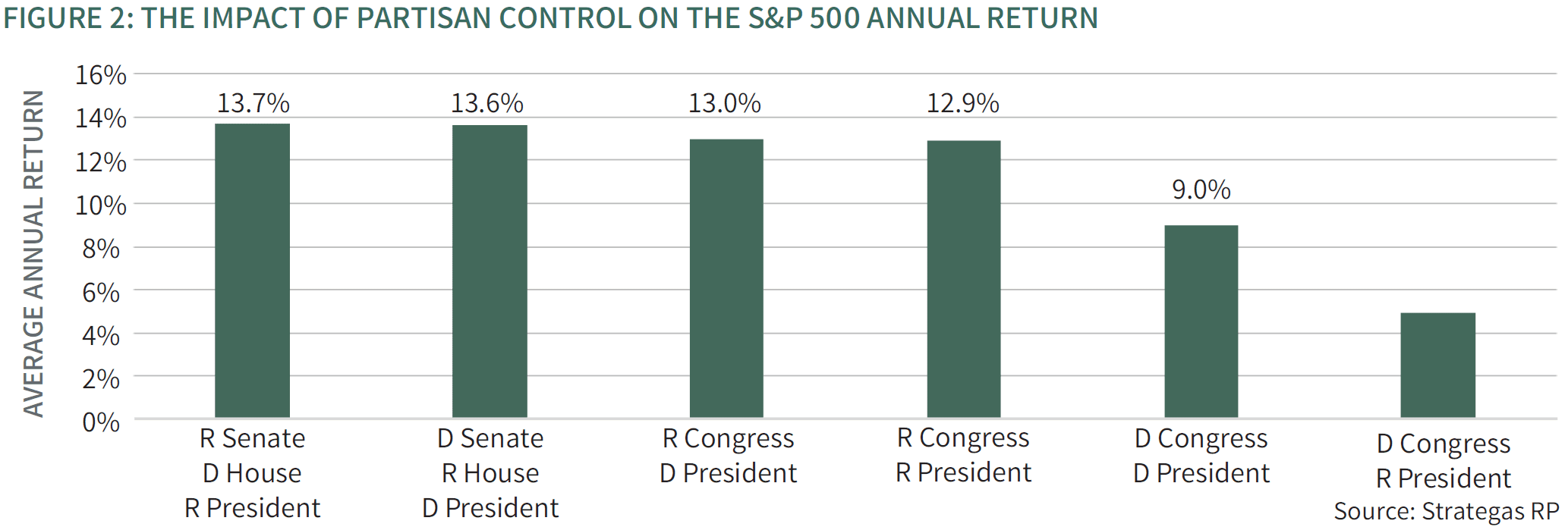
Graph highlighting the impact of partisan control on the S&P 500 annual return

Conclusion

In short, presidential elections matter for people and for intra-year volatility, but in general don’t have an outsized impact on future returns. Data has shown that the most prudent course of action is to remain invested while the volatility plays itself out and make strategic portfolio changes after the dust has settled.

If you have questions, please reach out to your advisor.

Information contained herein is for general educational purposes only and is not intended to be substituted for personalized investment, financial, tax, or legal advice as individual situations can vary. The use of charts, graphs, formulas, and other illustrations are not intended to be used independently to guide investment decisions or to determine which securities to buy or sell, or when to buy or sell them. Information was obtained from sources considered reliable, but no representations or warranties are made to its accuracy, timeliness, suitability, or completeness. Statements expressed are opinions of certain Godsey & Gibb Wealth Management personnel and are subject to change without notice. Forward-looking statements expressed herein are subject to change due to shifts in the market and economic conditions. Full disclosure: https://www.godseyandgibb.com/disclosure/

Disclosure: Our website contains links to third-party websites which are provided as a convenience only. These sites contain information by organizations independent of Godsey & Gibb Wealth Management. We do not endorse the content, advertisements, activities, nor the products of these linked websites. Furthermore, we do not receive compensation for linking to any third-party websites, or control these websites, and do not assume responsibility for the accuracy, completeness, or timeliness of the information located on these linked websites or provided through the third-parties. Accessing any linked third-party websites, tools or programs is at your own risk and subject to all terms, conditions, and privacy policies of those third parties. View full disclosure.